AMVI Mechanical Quick Revision
Chassis, Frame and Axle Fundamentals
The chassis is the vehicle's main supporting structure. In a conventional design, a separate frame carries the body, engine, transmission, suspension and loads. In unibody or monocoque construction, the body and structural members work together as one load-bearing shell.
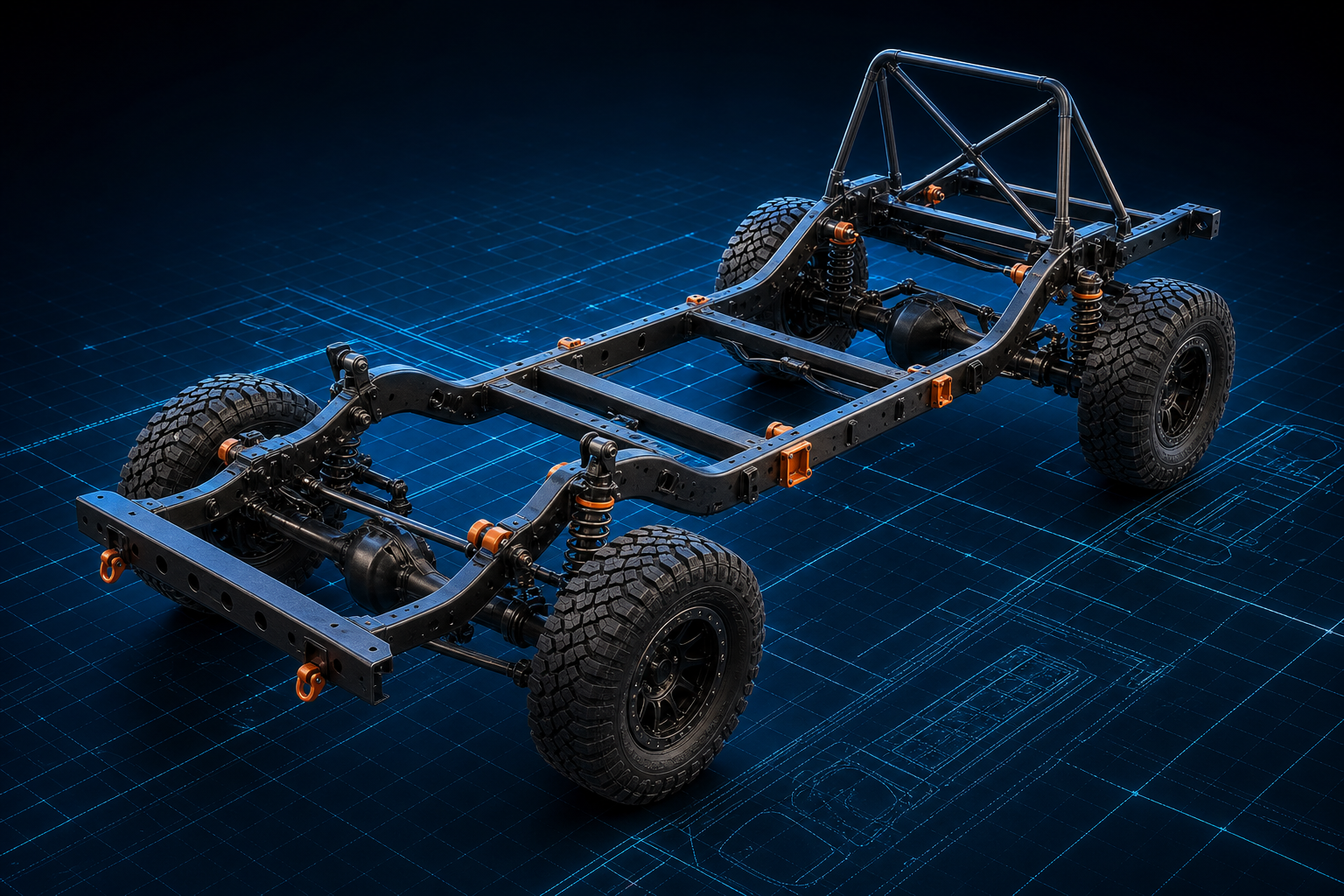
Ladder frame
Two long rails joined by cross members form a rigid, durable base. This separate-frame design suits trucks, buses and off-road vehicles.
Unibody chassis
The body shell and frame are integrated. Lower mass, efficient packaging and good crash performance make it common in passenger cars.
Axles
A live axle transmits drive; a dead axle supports weight without transmitting torque. Stub axles support and steer individual front wheels.
Cross member
Joins side rails and resists bending and torsional distortion.
Subframe
Carries assemblies such as suspension, steering, engine or drivetrain.
Roll cage
Creates a protective structure around occupants during a rollover.
Kerala PSC AMVI Question Bank
Chassis and Frame Questions with Answers
Select your answer mentally, then reveal the correct option and explanation.
2. What is the main purpose of a cross member in a chassis?
3. What is a ladder-frame chassis?
4. What is the purpose of a roll cage in a vehicle chassis?
5. What is a principal purpose of a subframe in a chassis?
6. What is a unibody chassis?
7. Which vehicle is most likely to use stub axles at the front?
8. What is the function of a ball joint in a front stub-axle assembly?
9. Which statement about a live axle is correct?
10. What is the purpose of a front dead axle?
Detailed Answer Notes
More Points for AMVI Revision
1. Steel chassis
- Resists bending, twisting, impact and repeated road loads.
- Easy to press, weld and repair with common equipment.
- High-strength low-alloy steel retains strength with thinner sections.
- Aluminium is lighter but costlier; carbon fibre is mainly for premium vehicles.
2. Cross members
- Prevent the two side rails from spreading or shifting.
- Improve torsional rigidity on uneven roads.
- Distribute loads and support components such as the engine or gearbox.
- Common forms include channel, box, tubular, X and K sections.
3. Ladder frame
- Handles high payload and towing loads effectively.
- A separate body can be isolated using rubber mounts.
- Durable, repairable and useful for trucks and off-road vehicles.
- Disadvantages include higher weight, floor height and fuel consumption.
4. Roll cage
- Main hoops, braces and side bars protect the passenger cell.
- Triangulation transfers rollover forces into reinforced mounts.
- It can also increase torsional stiffness.
- Correct tubing, welding, padding and restraint use are essential.
5. Subframe
- Provides accurate suspension and steering mounting points.
- May also carry the engine, transmission or differential.
- Rubber bushes isolate noise, vibration and harshness.
- Loose mounts can cause noise, poor handling and alignment changes.
6. Unibody
- Floor, sills, pillars and roof rails share structural loads.
- Lower mass improves economy, performance and packaging.
- Crumple zones absorb energy around a strong passenger cell.
- Unibody, unit construction and integral construction are related exam terms.
7. Stub axle
- Supports one wheel while allowing steering movement.
- The hub rotates on bearings around or within the spindle.
- Traditional types include Elliot, reverse Elliot, Lamoine and reverse Lamoine.
- Stub axles are not exclusive to front-wheel-drive vehicles.
8. Ball joint
- A spherical stud and socket permit movement in several planes.
- Allows steering rotation and suspension travel together.
- Wear may cause play, knocking and uneven tyre wear.
- The ball joint articulates; wheel bearings provide free rotation.
9. Live axle
- Axle shafts transfer differential torque to the hubs.
- The differential permits different wheel speeds while cornering.
- Provides high load capacity, ground clearance and articulation.
- Types include semi-floating, three-quarter-floating and full-floating.
10. Dead axle
- Supports weight but contains no driving differential or half-shafts.
- A forged front beam provides high load capacity in trucks and buses.
- Its ends carry steering knuckles through pivots or kingpins.
- “Dead” means non-driving, not stationary.
AMVI Mechanical Preparation
Build stronger automobile engineering concepts
Use these chassis and frame MCQs for Kerala PSC AMVI mechanical revision, then practise related topics such as suspension, steering geometry, brakes and transmission. Inspire PSC combines focused concept learning, previous-question practice and mock tests for AMVI aspirants across Kerala.
Learn. Practise. Succeed.
Prepare for Kerala PSC AMVI with Inspire
Strengthen AMVI mechanical concepts and practise exam-oriented questions wherever you are in Kerala.